
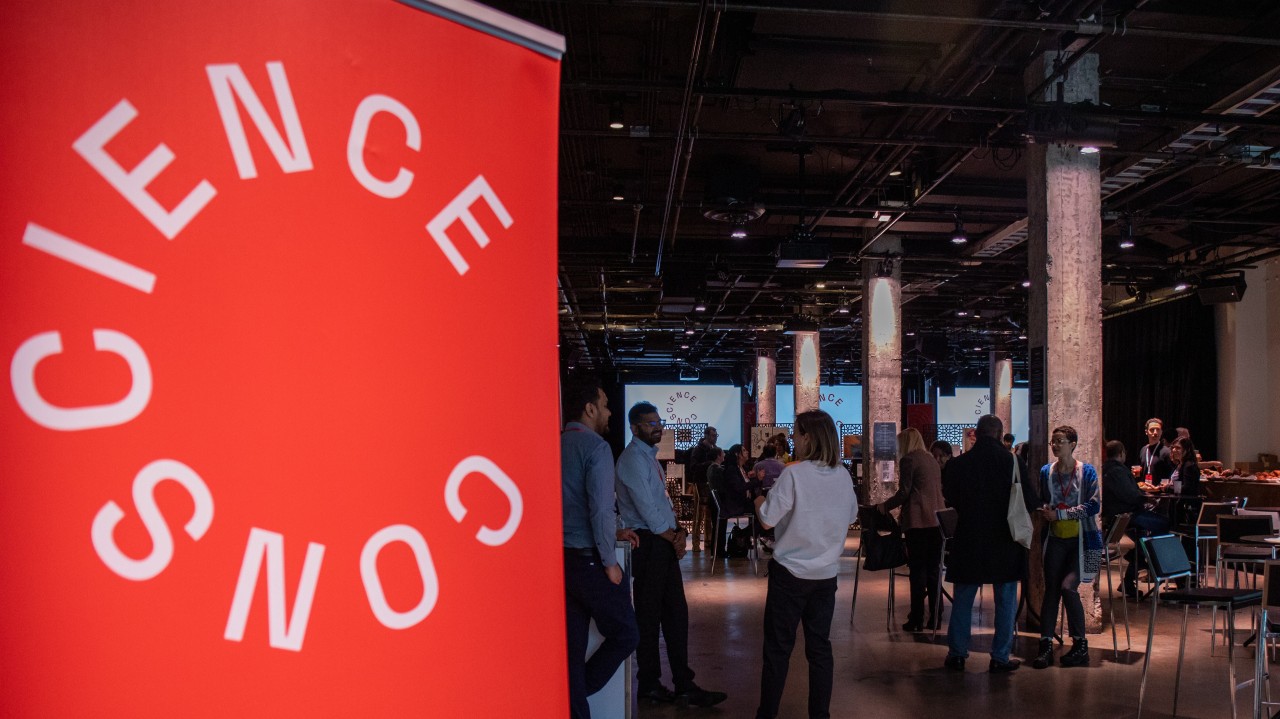
Reaching across Canada, Conscience is driven by a global mission: to ensure that every disease has a treatment, accessible to people wherever they are in the world. Yet, the unpredictable nature of diseases such as the emergence of future pandemics and the limited size of patient groups living with specific rare diseases make it difficult for companies to commit to the lengthy, costly process of patenting and developing treatments. This uncertainty discourages investment, leading to limited funding and significant barriers in drug development. Conscience aims to change this by introducing an open science model that uses novel intellectual property and business strategies that empower emerging companies to develop drug treatments more efficiently. Conscience is building a network connecting innovators and stakeholders to encourage open science practices and leverage powerful AI tools in drug discovery. By working towards the improvement of advanced algorithms for early-stage drug discovery and tapping into open-source databases, Conscience is making drug discovery more accessible and data-driven.
Launched in 2023 with support from the Canadian government, Conscience is uniquely positioned to fund Canadian small, medium-sized enterprises (SMEs) and academic researchers working in drug discovery. In addition, Conscience also aims to transform drug discovery into a team sport. While collaborations between pharmaceutical companies, universities, and startups do exist, issues surrounding patents and intellectual property rights often slow progress and consume valuable resources. Conscience's team sport philosophy is about forging closer, more agile partnerships by connecting people to the right experts and contributors at the right time. As Laurianne Gorce, Conscience's Senior Manager for Partnerships, put it, "When you create a drug compound, you don't know who to contact and who you can contact. We are working to eliminate those barriers."
One of its most impactful initiatives is leading the Critical Assessment of Computational Hit-finding Experiments (CACHE) challenges. Unlike other competitions where solutions are benchmarked against known answers, CACHE tackles real, unsolved problems. Teams use computational approaches and AI to identify potential drug starting points that target disease-causing proteins, a process known as hit-finding. The effectiveness of these hits is experimentally validated by the Structural Genomics Consortium (SGC) and the results are shared publicly. Each participating organization is eligible for up to $100,000 in support for experimental testing, and this might increase in the future.
Conscience also offers mentorship and project management support to guide startups and researchers in implementing open science practices in their drug development projects. One of its flagship programs is Developing Medicines through Open Science (DMOS), which supports drug discovery for rare or infectious diseases and antimicrobial resistance. So far, three projects have received funding through the DMOS program, working towards treatments and cures for three rare diseases: a genetic neuromuscular disorder, a pediatric brain cancer, and a liver disease. Among the recipients is Agora Open Science Trust, who are involved in all three projects and will receive almost $2.5M in funding from Conscience.
Conscience's approach is anchored on three pillars: open science, collaboration, and the use and improvement of AI to accelerate drug discovery. Through initiatives like CACHE and DMOS, it has created new opportunities for collaboration between startups and academic teams in drug discovery. Most recently, Conscience hosted a Symposium in April featuring a wide range of talks and workshops that explored how AI and open science can be harnessed to develop new medicines particularly for rare diseases and antimicrobial resistance.
Through all of these efforts, Conscience is reshaping the landscape of biomedical research, working toward a future where no disease is left without a treatment, and where the phrase "incurable disease" becomes a thing of the past.